
The legal set
Seal Use Rules
How a business with a current HCC record may show the seal: where, in what form, with which words, and what happens when the seal is misused.
Version 1. In effect from October 15, 2026.
These rules will be part of the Check and Membership Agreement (section 14) that every business signs before its check. HCC publishes that agreement before it accepts any application. They are published here so customers, directories and anyone else can see exactly what a business may do with the seal, and hold it to that. Every member's seal depends on HCC enforcing these rules evenly (section 12).
The ten rules on one page
- Show the seal only while your record says Verified, and only at the location named on the record.
- Use only HCC's live embed, or the decal, card and sticker HCC supplies. Never change the seal.
- Never show it smaller than the minimum size.
- Never add Arabic characters to the seal or beside it.
- Never use the word "certified" with HCC's name or the seal.
- Always use the full name "Halal Community Council".
- Name your real halal source (your supplier or certifier) wherever you say "halal".
- Use the seal only for what your record covers.
- When your status ends, remove the seal within 7 days.
- Follow your state's halal law. This document covers Virginia, Maryland, Michigan and Illinois in section 10.
1. What the seal says, and what it does not
1.1 What it says. The seal says that Halal Community Council checked this location, at this level, on the date shown, within the scope written on the record. The QR code and the link open the record, where every fact is listed with its date and basis:
- Seen: HCC examined a document.
- Observed: HCC saw it on a visit.
- Stated: the business told HCC.
1.2 What it does not say. The seal does not say that any food is halal. HCC does not rule on religion. The seal is not a halal certification. It says only that HCC checked the named facts at the stated level. The seal is not a guarantee. It does not cover food safety, and it does not cover anything outside the record's scope.
1.3 The three levels.
| Level | On the seal | What HCC checked |
|---|---|---|
| Cornerstone | One ring | Supplier invoices and certificates for the items in scope. One visit, in person or by live video (in person where the location also serves non-halal items, Standard 3.5). The five counter questions put to staff. |
| Pillar | Two rings | Everything in Cornerstone, plus every item the location calls halal with meat, poultry, gelatin or animal fat traced to a certified source. Separation observed in person, and staff through the HCC staff course. |
| Keystone | Gold center | Everything in Pillar, plus two unannounced visits a year and an imam's review of the file. A monthly watch on every supplier certificate, and the owner's sworn statement of every source. |
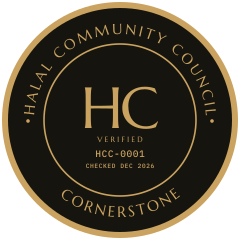 Cornerstone
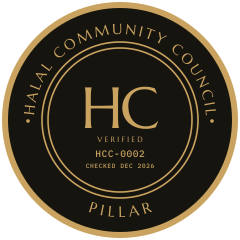 Pillar
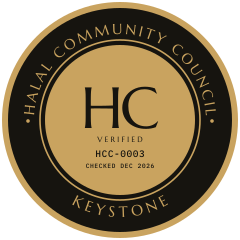 Keystone
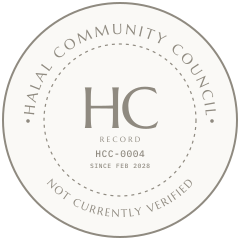 Not current (HCC only)
1.4 The not-current seal is HCC's alone. When a status ends, HCC's own pages show a gray seal that reads "Not currently verified". The business never displays it.
2. Who may show the seal
2.1 Members with a current status. Only a business whose record shows Verified may show the seal. It may show it only at the location named on that record, and only at the level shown there.
2.2 One location, one seal. A seal belongs to one location. A business with several locations shows a seal only at the locations that have their own Verified record. Each location shows its own level.
2.3 Never-seal rule. No business under the same ownership or control as HCC's member may carry an HCC seal. That includes a business owned or controlled by the spouse or household of a person who owns HCC's member. Nor may a business owned or controlled by an HCC director, officer or committee member, while that person serves. A business stays under this rule for 24 months after its tie ends (Standard 11.4). Such a business may be listed in the Register with an outside certifier's certification shown as an attributed fact, with the line "Affiliated with HCC. Not eligible for an HCC seal." It may show its outside certifier's mark under that certifier's own rules. It never shows HCC's seal.
2.4 Not suppliers or partners. A supplier to a member, a perks partner or any other business may not use the seal to describe itself or its products.
2.5 Event checks. An event check produces an event record, never a seal. A caterer may share the link to that event's record for that event only. It may not show the seal.
2.6 HCC's own use. HCC uses the seal only to show status and to explain or promote the program. Neither HCC nor any business under common ownership with HCC sells food or catering under the seal.
3. The approved forms
HCC supplies everything in this section in your seal kit. Use nothing else.
3.1 Live embed (websites). Your seal kit gives you a short code like this:
- A link to your record: https://halalcommunitycouncil.com/
r/HCC-0001 - Around the live seal image: https://halalcommunitycouncil.com/
seal/HCC-0001.svg - With this alt text: "HCC Verified: Pillar. Halal Community Council, record HCC-0001."
- At this width: 120 pixels
The image comes from HCC's server, so it always shows your current status. When your status changes, the image changes the same day.
- Keep the link to your record.
- Keep the alt text.
- Do not download the image and host your own copy.
- Do not add filters, overlays, borders or animation.
3.2 Window decal. HCC prints it, with a QR code that opens your record. Your dues include two decals, replaced after each re-check. A location with more than two public entrances may order extra decals at cost, $10 each.
3.3 Counter card. HCC prints it, with the QR code. It goes at the point where customers order.
3.4 Menu sticker and print file. HCC supplies stickers and a print file for printed menus. Each carries the QR code or the record's short web address.
3.5 Static image, only where an embed is impossible. Some delivery apps and social platforms do not allow a live embed. There you may use the static image from your seal kit, with two conditions:
- Put the record's web address in text right next to it, for example halalcommunitycouncil.com/
r/HCC-0001 . - Remove the image within 7 days after your status ends.
3.6 Approved colors. Use only the color versions in your seal kit, exactly as supplied. Never make your own.
4. How the seal must look
4.1 Never altered. Show the seal exactly as HCC supplies it. Never do any of these:
- redraw, recolor, crop, stretch, rotate, outline or animate it
- add words, symbols or a frame
- remove the record number, the date or the QR code
- cover the QR code, or replace it with your own
- join it with another mark to make a combined badge
One exception: in Maryland, HCC supplies a separate companion strip that carries the business's English statement (section 10, Maryland). It goes under the decal or card. It is the business's statement, not part of the seal.
4.2 Minimum size. Never show the seal smaller than these sizes:
- Print (decal, card, menu, flyer): at least 0.75 inch (19 mm) across.
- QR code on print: at least 0.8 inch (20 mm) square, so it scans.
- Screen: at least 64 pixels wide at normal display size.
4.3 Clear space. Keep clear space around the seal on every side, equal to one quarter of the seal's diameter. Keep other text and images out of that space.
4.4 Latin letters only. The seal uses Latin letters only. Never add Arabic characters to the seal, inside its clear space, or on the same decal, card or sticker. Maryland and Michigan attach sign duties to Arabic characters a business displays (section 10). Only HCC issues versions in other languages. A French seal for Quebec and a Spanish seal for Mexico will come later.
4.5 Never "certified". Never put the word "certified" on the seal, next to it, or in any statement about HCC or its check. You may still say that an outside certifier certified your supplier or your products, because naming your real source is required (5.3). If you do:
- Keep it clearly about that certifier: "certified by certifier".
- Keep it in a separate sentence from any mention of HCC.
4.6 Always the full name.
- Any text that refers to the seal or the check includes the full name "Halal Community Council".
- "HCC" may follow the full name in the same place, but it never stands alone as the name of the seal's issuer.
4.7 Your level only. Show only the level your location passed. Never show a higher level, and never suggest that every level applies.
4.8 Current only. The seal is never shown as current after a status ends. Each seal shows the month and year of its check (Standard 10.3). After a renewal, your new Good through date is your prior Good through date plus 12 months, even when the re-check was decided early (Standard 8.1). HCC sends new decals after each re-check, included in your dues, and you replace the old ones.
5. Words: what you may say, and what you must never say
5.1 Sentences you may use. Fill in your own details:
- "HCC Verified: Pillar. Halal Community Council checked this location on date. See the record: halalcommunitycouncil.com/
r/HCC-0002." - "Our chicken and lamb come from supplier, certified by certifier. Halal Community Council checked our invoices and our kitchen at the Pillar level: halalcommunitycouncil.com/
r/HCC-0002." - "Halal Community Council's check covers the items marked * on this menu. See record HCC-0002."
5.2 Words you must never use.
| Never say | Why |
|---|---|
| "HCC certified", "Certified by Halal Community Council", "Halal certified (HCC)" | The seal is not a halal certification. HCC does not say that food is halal. It says only that HCC checked the named facts at the stated level. |
| "Verified halal", "Halal verified", "HCC says our food is halal" | HCC never says food is halal. It states what it checked. |
| "Guaranteed halal", "100% halal, verified by HCC" | HCC gives no guarantee. |
| "Approved by HCC", "Endorsed by HCC", "HCC-approved" | HCC does not approve or endorse food or businesses. |
| "HCC" with no full name | The full name is always required. |
| Any level your location did not pass | The seal shows depth of checking, and only what was done. |
| "The only verified place in town", or any claim about a competitor | The seal is about your location only. HCC's records are never used against another business. |
| "Your purchase supports HCC" | Buying from you does not fund HCC, and this wording can bring charity-law duties. |
| "Halal-certified vendor" (in Illinois) | See section 10, Illinois. |
5.3 Your halal source, every time. Wherever you say "halal", name the supplier or certifier you rely on. The seal never takes the place of that name. Your record shows the same source.
6. In the window, at the counter and on the menu
6.1 Window or door.
- Put the decal on the entrance window or door of the location named on the record, at about eye level.
- Place it where the QR code can be scanned from outside.
- Use one decal per public entrance.
6.2 Counter. Put the counter card where customers order. Keep it upright, readable and unobstructed.
6.3 Printed menus and menu boards.
- Put the menu sticker or the printed seal on the page or panel that the record covers, next to your halal source statement. For example: "Halal source: supplier, certified by certifier."
- If the record covers only some items, mark those items. Add the line: "Halal Community Council's check covers items marked *. See record HCC-number."
- Never place the seal so that it suggests the check covers the whole menu when it does not.
6.4 Mixed menus and mixed stores. If you sell both halal and non-halal food, every HCC level requires you to label each non-halal item clearly as non-halal at the point of sale: on the menu, menu boards, displays, package labels and delivery apps (Standard 3.5). Never place the seal on or beside a non-halal item. Your state may also require signs or labels. See section 10 and your state module in the Standard. The seal never replaces them.
6.5 Not on products, packaging or vehicles. The seal describes a location, not a product. Never put it in any of these places:
- product labels or packaging
- shelf tags for packaged goods
- food sold to other businesses
- vehicles, uniforms or merchandise
One exception: a market or butcher may use a shelf or case card that HCC supplies. It names the level and the record number, and goes only beside items in scope.
6.6 Catering. Use the seal on catering menus, quotes or materials only if the record's scope includes catering.
7. Online, delivery apps, social media and advertising
7.1 Your website. Use the live embed (3.1). Place it on the pages about the location named on the record.
7.2 Delivery apps and listing sites. Where the platform allows an image, use the static image under 3.5. Otherwise, use a text line, for example: "Halal source: certifier. HCC Verified: Pillar, by Halal Community Council: halalcommunitycouncil.com/
7.3 Social media. You may use the seal in these places, each time with the record link in the text:
- your profile image or cover
- a pinned post
- posts about the location
When your status ends, remove the seal within 7 days from every profile image, cover, bio, link page, pinned post and advertisement, and remove every live embed. Older posts need not be deleted.
7.4 Advertising.
- You may advertise your status for the verified location, using the full name, your level and the record link.
- An advertisement for several locations names the verified locations. It never suggests that all of them are verified.
7.5 Directories. Directories that license HCC's status feed show your status under the Status Feed License, not under these rules (section 11).
8. Scope: use the seal only for what your record covers
8.1 Match the record. Use the seal only next to items, menu sections or services that your record's scope covers.
8.2 Partial scope. If your record covers part of your menu, say which part. If it excludes catering, sealed packaged items or anything else, never use the seal for those.
8.3 Changes. If a change takes something out of scope, stop using the seal for it at once. Report the change to HCC within 14 days (Check and Membership Agreement, Schedule E).
9. When your status ends
Your status ends when:
- your renewal is not paid by the anniversary
- your re-check does not pass and is not fixed by the anniversary, even if an appeal is still open (Standard 8.1 and 8.2)
- your seal is withdrawn after notice and appeal
- your location closes or moves
- your agreement ends. If you end it yourself, your status ends on your good-through date (Check and Membership Agreement, 19.3).
After a failed re-check, your record shows "renewal not completed" until the time to appeal ends or the panel decides, then "withdrawn after notice and appeal" (Standard 8.2(3) and 10.1).
What happens next:
- On that day, your live embed turns to the gray "Not currently verified" seal. Remove it from your site.
- Within 7 days, take down every decal, counter card and menu sticker. Remove the seal from printed menus, menu boards and flyers that are still in use. Remove every static image, every profile or cover image, and every advertisement that shows it.
- Within 7 days, remove every text claim that uses HCC's name about that location.
- Confirm in your portal that you have finished.
Printed menus can take time to replace. Until they are reprinted, cover the seal and any HCC wording with a blank sticker. A blank sticker counts as removal within the 7 days.
10. State rules
Your state's halal law is your own legal duty. HCC's check includes the state items in the Standard, but HCC files nothing for you, and these rules are not legal advice.
Virginia (Va. Code 3.2-5124)
What the law says. HCC read this text on the official Virginia site:
"It is unlawful to label any repackaged food or food product or display or offer for sale any unwrapped food or food product that represents the food or food product as kosher or halal without indicating the person or entity authorizing such designation by providing the name or symbol of the authority or providing a phone number or website to access the information."
A knowing violation is a Class 3 misdemeanor.
What to do in Virginia. These steps are a required term of your agreement for a Virginia location. They match the Virginia module in the Standard (VA-01 to VA-05).
- Show an authority line. Put one on every label of repackaged food you call halal, and on every display or offer of unwrapped halal food: case cards, menus, boards, signs and online menus. The line gives either:
- the name or symbol of the authority, or
- a phone number or website where the information can be had.
- Name your real halal source (the supplier or certifier you rely on) as these rules require everywhere (5.3).
- Where you use a website for the authority line, use your record's web address. Your record lists your named source and the scope of the check.
- Make sure the address works.
- If you also show the seal, show it with HCC's full name and the record's web address. HCC's Virginia seal kit includes HCC's phone number.
- Do not present HCC as the authority behind your halal claim. HCC states what it checked. Your certifier or supplier is the source.
- Never put the seal itself on product labels or packaging (6.5). The authority line on a label is text.
Maryland (Md. Code, Com. Law 14-3601 to 14-3604)
What the law says. HCC read the official text:
- A business that claims to the public that unpackaged food is halal must post a disclosure statement on the form the Consumer Protection Division develops. It must keep copies for 3 years, give a copy to the Division within 2 business days of a request, and follow the statement in practice (14-3602(a)).
- A representation includes an emblem, insignia or mark that could lead a consumer to believe the food sold there is halal (14-3601(i)). A seal on a window is a representation by the business.
- A business that sells both halal and non-halal food or meat must post 4-inch window signs (14-3602(b) and (e)).
- Section 14-3602(f)(2) reads:
"In connection with any place of business that sells or offers for sale any food, a person may not display, whether in a window, door, or other location on or in the place of business, in any handbill or other printed matter distributed in or outside of the place of business, or otherwise in any advertisement, any Arabic characters, or any other representation to the public that the place of business sells or offers for sale halal food or meat, unless the person also displays in conjunction with the Arabic characters or other representation, in English, letters of at least the same size as the Arabic characters, the words 'we sell halal meat and food only', 'we sell nonhalal meat and food only', or 'we sell both halal and nonhalal meat and food', as appropriate."
- In Maryland, "Arabic character" includes any Arabic word or letter, and any mark that simulates one (14-3602(f)(1)). Unlike Michigan, Maryland does not exempt the word "halal" written in Arabic.
- A violation is an unfair or deceptive trade practice under Title 13 (14-3604).
What to do in Maryland:
- Before you show the seal, post the Division's halal disclosure statement. Keep it matching what you actually do, and keep copies for 3 years. HCC's Maryland check treats "disclosure statement posted and matches practice" as a pass or fail item.
- If you sell both halal and non-halal food or meat, post the 4-inch signs the law requires.
- Use HCC's Maryland companion strip. HCC supplies a separate strip, printed to go under the decal and the counter card. It carries the one English statement that is true for you: "we sell halal meat and food only" or "we sell both halal and nonhalal meat and food". It is your statement, in your voice. It is not part of HCC's seal, and HCC does not make the statement.
- Use the same statement in any printed matter or advertisement that shows the seal.
- Print it in letters at least as large as the largest letters on the seal.
- Never add Arabic characters near the seal. If any of your own signs or advertisements use Arabic characters, including the word "halal" in Arabic, Maryland requires one of the English statements in letters at least as large as the Arabic.
- Tell HCC within 14 days if you change your disclosure statement.
Michigan (MCL 750.297f)
What the law says. HCC read the official text:
- Michigan defines halal as "prepared or processed in accordance with Islamic religious requirements" (subsection (1)).
- With intent to defraud, these are misdemeanors:
- falsely representing food as halal
- failing to identify halal meat or halal food when both halal and non-halal are displayed (subsection (2)(c))
- displaying "words or letters in Arabic characters other than the word 'halal'", or a mark simulating them, without the matching English statement (subsection (2)(d)). The statement is "we sell halal meat and food only", "we sell nonhalal meat and food only", or "we sell both halal and nonhalal meat and food", in English letters of at least the same size.
- Possessing non-halal food in a place that advertises halal only is presumptive evidence of intent to defraud (subsection (3)).
- The Department of Agriculture investigates and enforces (subsection (5)).
What to do in Michigan:
- If you sell or display both halal and non-halal meat or food, identify the halal items as "halal meat" or "halal food".
- Never add Arabic characters to the seal or near it. Your window, door, place of business or handbills may show Arabic words or letters other than the word "halal", or a mark that imitates them. If they do, also show in English, in letters at least the same size: "we sell halal meat and food only", "we sell nonhalal meat and food only", or "we sell both halal and nonhalal meat and food".
- If you say "halal only", make sure no non-halal food is on the premises.
Illinois (815 ILCS 505/2LL; 8 Ill. Adm. Code Part 190; 410 ILCS 637)
What the law says. HCC read the official text:
- A "dealer" that represents food as halal must register each location with the Illinois Department of Agriculture before selling it. The fee is $75 per location, and the registration is valid until June 30 each year (190.20).
- The registration gives "the name, address, and phone number of the certifying entity".
- The dealer files a disclosure statement and signs that "All food labeled halal is kept in the halal way and is from halal sources". The registration is posted in the store.
- Where both halal and non-halal food are sold, the dealer posts a window sign in letters at least 4 inches high: "Halal and Non-Halal Foods Sold Here" or "Halal and Non-Halal Foods Served Here" (190.30(c); 410 ILCS 637/15(8)). It also uses separate "halal food" and "non-halal food" signs over displays, separate cabinets or dividers, and dedicated utensils (637/15(10)).
- Records are kept for 2 years (190.50). Violations are referred to the Attorney General (190.100).
- Under 410 ILCS 637, false halal representations and several sign failures are Class B misdemeanors.
- Illinois has no filing duty for a certifier. Every duty falls on the dealer.
What to do in Illinois:
- Register each location with the Illinois Department of Agriculture before you offer food as halal. Renew by June 30 each year. HCC reminds you by May 15, and you send HCC proof of the new registration by July 15.
- In the registration, name your real certifying entity: the certifier whose certificate covers your halal items, or your supplier's certifier, with that body's address and phone. Never name Halal Community Council. HCC verifies; it does not certify, so it is not your certifying entity. Never give a person's name or a home address.
- Name your real halal source as well. List your suppliers and their certifiers on the disclosure statement, and on your menu and signs as these rules require (5.3).
- The statement you sign for the registration, "All food labeled halal is kept in the halal way and is from halal sources", is your own statement. HCC does not make it.
- Post the registration in the store. Send HCC a copy through your portal within 14 days.
- If a registration you filed names HCC, amend it within 14 days to name your real certifying entity, and send HCC the confirmation. If HCC does not receive it, HCC tells IDOA in writing that it is not the certifying entity for that location.
- If you sell both halal and non-halal food, put up the signs and keep the separation and dedicated utensils the law requires.
- Keep your records for 2 years.
- Know the limits of the seal. Relying on HCC is not a defense under Illinois's Consumer Fraud Act. Its reliance defense, in 2LL(c), lists farms, slaughterhouses, manufacturers, processors, packers and distributors, not certifiers. The good-faith reliance defense in 410 ILCS 637/10(c) applies only to the criminal offense in 637/10(a).
- Never describe the seal as making you a "halal-certified vendor" for state hospitals or prisons (410 ILCS 637/25).
New York and New Jersey: closed
HCC does not check locations in New York or New Jersey until its lawyer answers the certifier and supervisor filing questions in those states. No seal may be shown at a New York or New Jersey location, or in advertising for one. A business there may join HCC's free notify-me list: email only, no application and no payment.
Other states with halal laws
Your state module in the Standard lists your items. In short:
- California (Penal Code 383c): sellers of both halal and non-halal meat or food post signs in letters at least 4 inches high.
- Texas (Bus. & Com. Code 17.882): a store selling both halal and non-halal meat labels each portion of halal meat "halal". Display cases of unwrapped meat are labeled "halal" or "nonhalal".
- Washington (RCW 69.91): no sign rule. Knowingly selling food represented as halal when the seller knows it is not halal is a gross misdemeanor.
- Minnesota (Minn. Stat. 31.658): no halal sign rule. Possessing non-halal food in a place of business is presumptive evidence of exposing it for sale.
Canada and Mexico: not open yet
When HCC opens there, it will add rules here:
- Canada: a halal claim must show the certifier's full name (Food and Drug Regulations B.01.050). In Quebec, French is required.
- Mexico: Spanish is required, and HCC never claims to meet NMX-F-595-SCFI-2015.
11. Directories and listing sites
A directory that licenses HCC's status feed follows the Status Feed License:
- It shows status exactly as HCC publishes it, and it links the record.
- If it is under common ownership with HCC, it shows a visible line saying so.
- It never sells the food or services HCC checks, and it takes no commission on them.
- HCC takes no share of its placement revenue.
- A directory never presents the seal as its own badge, filter brand or paid feature.
12. Misuse and enforcement
12.1 Why HCC enforces. A certification mark can be canceled if its owner does not control how it is used, or permits uses of it outside the program the Standard sets out (15 U.S.C. 1064(5), in summary). Every member's seal depends on HCC enforcing these rules evenly.
12.2 What counts as misuse.
- Showing the seal at a location without a current Verified record. That includes a location that was never verified, has lapsed, was withdrawn, has closed or moved, or is not the location on the record.
- Showing a higher level than the location passed.
- Altering the seal (4.1), showing it below the minimum size (4.2), or copying the live image instead of embedding it.
- Adding Arabic characters to the seal or beside it.
- Using any word HCC never allows with its name or the seal: "certified", "guaranteed", "approved", "endorsed", "verified halal" or "100% halal".
- Using "HCC" without the full name.
- Using the seal for items, catering, events, products or packaging outside the record's scope.
- Saying "halal" without naming your halal source.
- Keeping the seal up more than 7 days after the status ends.
- Using the seal in claims about competitors, or saying that purchases support HCC.
- Registering or using a name, mark, domain or social media handle confusingly similar to HCC's.
12.3 Steps for a member.
- Notice to fix. HCC sends written notice of the misuse and what to change. The time to fix runs from the notice.
- Within 2 business days for serious misuse: the seal shown at a location without a current Verified record, a higher level shown than the location passed, or the word "certified" added. The same applies to an expired seal still shown online.
- Within 7 days for any other misuse.
- If it is not fixed, or happens again within 12 months, it becomes a ground for withdrawal. HCC then follows the notice, cure and appeal steps in the Check and Membership Agreement, section 13.
- Every case is logged in HCC's status log, with dates.
12.4 Steps for anyone else. This covers counterfeit seals, and uses that continue after the 7 days.
- HCC sends a written demand to stop.
- HCC may ask the platform involved, such as a delivery app or social network, to remove the image.
- HCC may publish a factual notice, for example: "HCC has no current record for business name at address."
- HCC may tell the state agency that enforces that state's halal law, where the misuse is also a halal claim. HCC takes no enforcement role itself.
- HCC, or the current owner of the marks, may take legal action under trademark and unfair competition law.
13. Reporting misuse
Anyone can tell HCC about a seal that looks wrong, through "Share a concern" or the link on any record. HCC acknowledges reports within 2 business days. A report is never published, and HCC does not reveal who made it without that person's consent.
14. Changes to these rules
HCC may change these rules with 30 days' notice to members. A change the law requires may apply sooner. HCC publishes the current version, with its date, on this page.
Read with these rules
- The HCC Standard, Version 1: what HCC checks at each level, the state items, and how a seal is withdrawn after notice and appeal.
- What the seal means: the same limits, written for customers.
- How we stay fair: the never-seal rule and who signs every decision.
- Your state's halal law in plain words: the ten states with a halal law, with links to each law.
- The Check and Membership Agreement: the contract every business signs, which includes these rules (section 14).
Your state's halal law is your own legal duty. These rules are not legal advice.
Every seal opens its record.
Scan the QR code or follow the link beside any seal. If the record does not say Verified for that place, tell us.